

DT独家专访 | Algenesis:如何将生物基PU“穿”进全球鞋底

Editor's Note: In August 2025, when U.S. bio-based materials company Algenesis announced the pilot production of its world's first non-phosgene bio-based isocyanate, the attention of China's bio-based industry was quickly captured. How did this company, rooted in algae research and only nine years old, break through the decades-long phosgene dependency of the polyurethane industry? What insights does its commercialization path offer to Chinese companies?
In January 2026, the Bio-based Energy and Materials team exclusively connected with Algenesis's headquarters in San Diego for an in-depth conversation with CEO Stephen Mayfield and CTO Ryan Simkovsky — marking the company's first interview with Chinese media.
文 | 陈竞芬
排版 | 何玉婷
Character Profile: The "Crossover Duo" from Lab Bench to Industrial Shelf

Distinguished Professor of Biology at the University of California, San Diego (UCSD), former Director of the California Center for Algae Biotechnology, with over 30 years of deep expertise in green algae molecular genetics. He is a classic example of a scientist turned serial entrepreneur: co-founded Rincon Pharmaceuticals in 2005, Sapphire Energy in 2007, Triton Health and Nutrition in 2012, and Algenesis in 2016.

Ph.D. in Biology from the Massachusetts Institute of Technology (MIT), with nearly 30 years of experience in scientific research and project management. Before joining Algenesis, he served as a Project Scientist at UCSD, leading multiple U.S. Department of Energy-funded projects in algae biotechnology, specializing in translating fundamental research into intellectual property and industrial technologies.
We might be the people who wear their own materials the most in the world." On the other end of the screen, Professor Mayfield picked up a light brown casual shoe from his feet — a sample made from their self-developed bio-based TPU.
In 2016, when Mayfield decided to start another venture, he and Simkovsky carried with them a profound lesson from the biofuel sector: "It's easy to make things that burn, but it's nearly impossible to compete with cheap oil." This time, they pivoted completely — not to make "greener alternatives," but to create "high-value materials with superior performance and sustainability."
In August 2025, the answer arrived: the world's first 100% plant-based, non-phosgene isocyanate (Bio-Iso™) pilot plant went into operation. This is not just a technological breakthrough; it is a precise and profound "supply-side reform" targeting the polyurethane industry — a traditional sector worth over a hundred billion dollars annually and heavily reliant on highly toxic phosgene.
Through a pragmatic combination of technology and commercialization, Algenesis has quickly established its industry position: In October 2025, it won the Polyurethane Innovation Award from the American Chemistry Council's Center for the Polyurethanes Industry (CPI); its TPU and polyols received the USDA BioPreferred® certification; and it secured a threefive-year awardcontract worth approximately $6 million from the U.S. Department of Energy.
01
Why All-in on PU?
"If you can make a shoe sole that performs better and is biodegradable, brands are willing to pay an extra $0.50 per pair. But if you say you can make cheaper gasoline, the market will only ask you: 'Can it be cheaper than Saudi crude?'"
Before polyurethane, Mayfield and Simkovsky experienced the harsh realities of biofuels firsthand — $0.50 per kilogram is already considered expensive for fuel, making it extremely difficult for bio-based routes to compete head-on with petroleum. This experience taught them a core principle: For bio-based materials to survive, they must enter high-value, performance-driven niche markets.
Polyurethane (PU) is currently the only synthetic polymer material applied across seven major fields: plastics, rubber, foams, fibers, coatings, adhesives, and functional polymers. As an elastomer, its flexibility, abrasion resistance, and tear strength far exceed those of ordinary plastics. "Elastomers are much more valuable than ordinary brittle plastics because they can do more things."
The real technical barrier lies in isocyanates — traditionally produced using highly toxic phosgene, making bio-based substitution extremely challenging. Algenesis's core breakthrough, the Bio-Iso™ technology (100% plant-based, non-phosgene isocyanates), is exclusively licensed from UCSD. After years of optimization, it has entered pilot production. Current capacity is 1 kg/day, with plans to increase to 10 kg/day within months.
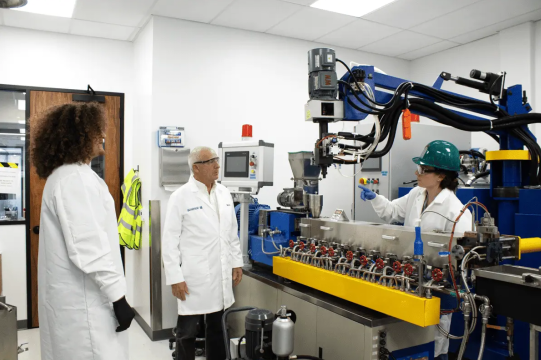
Algenesis employee Marissa Tessman (right) and CEO Stephen Mayfield discuss the company's twin-screw reactive extruder. Photo courtesy of Algenesis Labs.
"At the current small scale, costs are relatively high, but from a first-principles perspective — just looking at raw material and conversion costs — there is a clear path to price parity with petroleum-based products," Simkovsky stated. "As they often say in business, the devil is in the details. The entire process involves many steps, and each one needs optimization." This is precisely the common challenge for startups: finding the balance between "optimizing unit operations" and "scaling up in parallel" — scaling blindly with inefficient unit operations leads to high costs; over-optimizing without scaling prevents achieving economies of scale.
02
The Biodegradation "Dial": Designing Materials that are Both Stable and Controllable
"Our materials are completely stable during normal use. They only begin to degrade when they enter environments rich in microbes and moisture — like a compost pile, soil, or the ocean. It's like a cotton shirt: you can wear it for years, but put it in compost, and it will decompose."
Biodegradable materials are often misunderstood as "not durable." Simkovsky cleverly dispels this with the cotton shirt analogy: cotton is biodegradable, yet a shirt can last for years because degradation requires specific conditions — microbes + moisture. Algenesis's polyester-based polyurethane behaves the same way.

LabsBiodegradation experiment: Soleic™ material shoe soles being broken down by microbes in a simulated marine environment. Source: Algenesis Labs.
Behind this lies core technology: precisely tuning the rate of biodegradation by adjusting the molecular structure. "We spend a significant amount of time understanding how to turn the dial on biodegradation," Mayfield explains. Single-use packaging needs to degrade quickly, while automotive components need to remain stable for 20 years — understanding and controlling degradation rates is the essence of material design. In March 2024, the company published a paper in Nature Scientific Reports with UCSD, verifying that microplastics from bio-based TPU can biodegrade rapidly.
Technological breakthroughs are only the first step. How to move from the lab to the market? Algenesis now faces the more complex challenge of commercialization.
03
Commercialization Breakthrough: Changing Habits is Harder Than Changing Chemistry
Starting with Premium, Prioritizing Europe
In October 2025, Algenesis announced a partnership with European chemical distributor Safic-Alcan to distribute its Soleic®™ bio-based polyurethane materials across Europe. "Europe not only has strict carbon policies, but consumers are also willing to pay a premium for sustainability, allowing brands to market low-carbon materials," Mayfield explained. This dual driver of policy and market makes Europe an ideal "landing point" for bio-based materials.
The customer selection strategy is clear: "A pair of Prada sneakers sells for $900; a pair of Target shoes sells for $10. If our material adds 25 cents to the cost of Prada's shoe, they wouldn’tdon't care. But for Target, that's a big problem." Startups often fall into the vicious cycle: small scale → high cost → no large orders → smaller scale. The way out is to start with brands willing to pay a premium, using that premium to ramp up production capacity, then gradually reduce costs and penetrate the mass market.
The Real Challenge: Human Habits
"Brands testing our materials found their performance very similar to the petroleum polymers they currently use, meeting all specifications," Mayfield said. The real challenge lies in "changing habits."
"If you go to a factory in Vietnam, the people there have never seen this material before. They are often resistant to trying something new — not because it's hard to use, but because they imagine it will be hard to use. So we have to go on-site to train them, explain what it is and how to use it." This "fear of the new" forces the Algenesis team to play the role of "technology evangelists."
Similar issues arise on the brand side. "Many companies, when they get our new material, also want to pair it with a completely new design. They want new material + new design + new colors to excite people. But every time you introduce a new design, unexpected problems pop up — like bubbles forming in the corners of a mold. Every new technology you add makes manufacturing a little harder."
Despite these challenges, market collaborations are steadily progressing. Besides the Next Stride project with brands like Adidas, Target, and Zalando launched in September 2025, publicly announced partners include Namu (launching products in December 2025) and their own brand Blueview. Approximately four other brands plan to launch products in spring 2026.
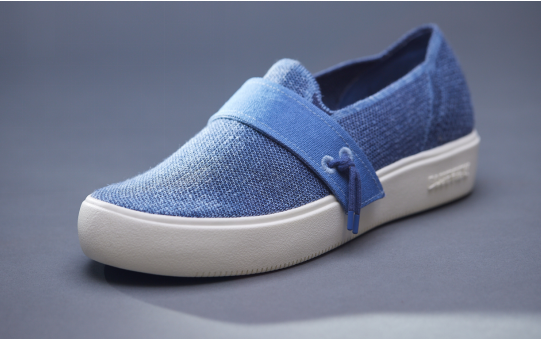
Blueview shoes. Source: Algenesis Labs.
A Supply Chain Strategy Combining Short and Long Term
For raw material supply, Algenesis adopts a "short-term + long-term" strategy. In the short term, they purchase bio-based intermediates like azelaic acid from existing suppliers. However, current azelaic acid mainly serves the biomedical market, with extremely high purity and high cost. "The chemical industry doesn't need such high purity and can't afford such high prices."
In November 2025, Algenesis announced a strategic partnership with P2 Science, which uses proprietary technology to efficiently convert vegetable oils into specialty chemical intermediates, potentially significantly lowering costs and expanding supply in the future. This forward-looking approach stems from the demands of major customers: "Companies like Adidas and Target always ask: 'It's great that you can make 10 tons, but can you make 10,000 tons? Because that's what we need. 10 tons wouldn't even fill two of our stores.'"
04
China Strategy: Manufacturing, Market, and Technology — A Triple Consideration
Algenesis's positioning towards China is multi-faceted:
As a Manufacturing Base: "Currently, we are primarily looking for Chinese manufacturers who can produce our polymers and monomers." China's robust chemical manufacturing capabilities make it an ideal partner for scaled production.
As a Target Market: They are in discussions with Chinese companies regarding material sales, recognizing China's vast end-consumer potential.
As a Technology Partner: "We are in dialogue with many large chemical companies, including Chinese ones," Mayfield revealed. "Once Ryan can demonstrate that this works at a commercial scale — say, reaching a few hundred kilograms per day — we will likely partner with a large chemical company to scale this up to tons per day and thousands of tons per year."
"Sometimes we don't get to choose which factory we go into. The brand says: 'It has to be within our supply chain; you can only work with these factories.'" Take the Reef brand, for example. Because their main factories are in Vietnam, Algenesis entered the Vietnamese market. "Now, some shoe brands we're talking to say their factories are in China, and we need to go to China to talk to them."
As a startup, resource constraints are a reality. "We can't be everywhere. We don't have enough employees to cover the globe. So we are 'slowly' entering China."
The Four-Step Capacity Roadmap:
1 kg/day (verified, August 2025) → 10 kg/day (within months, process stability verification) → hundreds of kg/day (next 1-2 years, demonstrating commercial potential) → tons/day, thousands of tons/year (post-partnership with large companies, achieving commercial production).
Algenesis's unique path can be summarized as: High-value positioning (elastomers) → Core technology breakthrough (non-phosgene Bio-Iso™) → Premium market cold start (European high-end brands) → Overcoming scaling and supply chain challenges → Gradually entering the mass market.
For China's bio-based industry, their journey offers three practical insights:Target High-Value Niches for
1.Technological Breakthroughs. Product selection logic determines success or failure: For bio-based materials to gain a foothold, the key isn't "what they can do," but "what they can do that commands a price." When petroleum-based products dominate low-cost markets, entering performance-driven, high-value segments is a more realistic choice. Chinese companies can learn from this approach, seeking space for technological premiums in specialized tracks.
2. Align Commercialization Pace with Resource Constraints. Startups face the vicious cycle: small scale → high cost → no large orders → smaller scale. The way out is to start with brands willing to pay a premium, using that premium to gain room for capacity expansion, then leveraging economies of scale to reduce costs and gradually penetrate the mass market. This means that in the initial stages, one need not aim for excessive scale; finding the first customers willing to pay for innovation is crucial.
3. Combine Short-Term and Long-Term Supply Chain Planning. Algenesis's collaboration with P2 Science demonstrates forward-thinking: when capacity is still at the kilogram level, they are already laying the groundwork for low-cost raw material channels to meet ton-level future demand. This "advanced layout" capability determines whether a startup can successfully cross from niche to mainstream markets. Supply chain thinking should be front-loaded; early alignment with upstream technology partners dictates how far one can ultimately go.
With the scale-up of non-phosgene technology and the unfolding of its China market strategy, Algenesis's journey is providing a significant blueprint for the global bio-based PU industry.
About Algenesis
Founded in 2016 and headquartered in San Diego, California, Algenesis focuses on the research, development, and commercialization of bio-based and biodegradable polyurethane materials. Its core Soleic®™ product line includes bio-based PU foams, TPU, and polyols, with bio-content ranging from 561-10087%. Compared to petroleum-based PU, these materials reduce greenhouse gas emissions by up to60-84% and have earned the USDA BioPreferred® certification. In 2025, the company received the Polyurethane Innovation Award from the American Chemistry Council's CPI, achieved EcoVadis Silver Medal (score 72, top 10% globally), and secured approximately $6 million in funding through a threefive-year awardcontract with the U.S. Department of Energy.
Interviewer's Notes
This conversation across the Pacific lasted nearly an hour. One statement from Professor Mayfield at the end was particularly memorable: "We're not trying to (overturn) the petrochemical industry; we just want to prove that bio-based can be better."
As an observer and participant in China's bio-based industry, the "Bio-based Energy and Materials" platform will continue to track Algenesis's capacity progress, market expansion, and technological breakthroughs. If you have further interest in the application, collaboration, or technical details of bio-based PU, feel free to contact us via our official WeChat account backend. We will connect with the Algenesis team to assist you.
The deep insights from this article will also be further explored in our upcoming industry reports and events. Follow us to not miss any key leaps in the global bio-based industry.
▌参考信息:本文部分素材来自DT产业研究院、生物基能源与材料。由作者重新编写,系作者个人观点,本平台发布仅为了传达一种不同观点,不代表对该观点赞同或支持。如果有任何问题,请联系我们:15356747796(微信同号)。
Activity Recommendation

Business Recommendation